
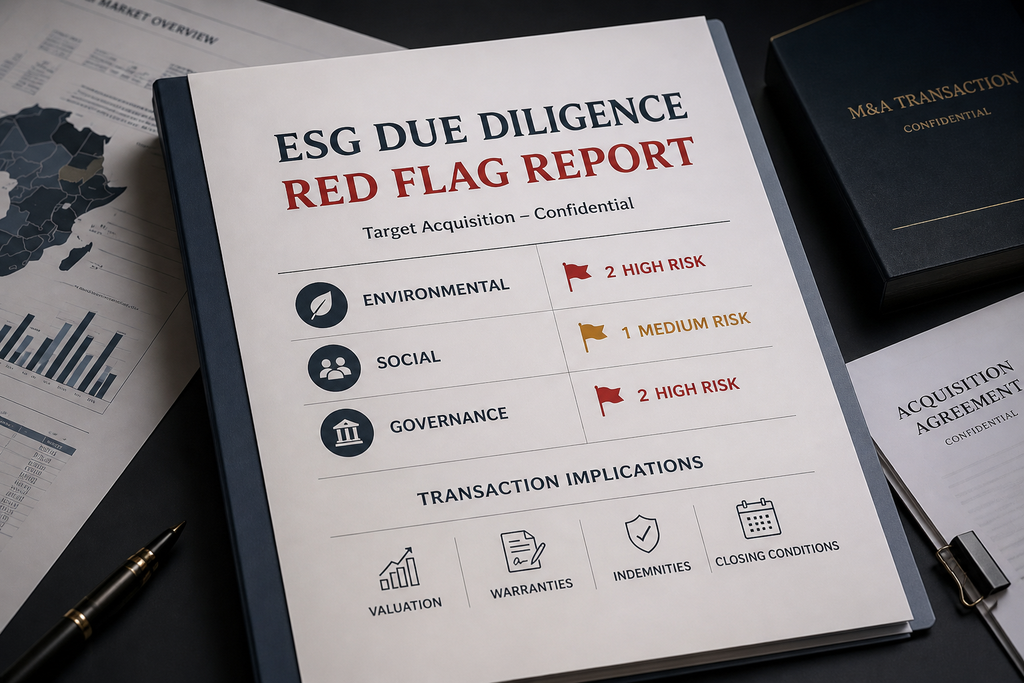
Environmental, social and governance (ESG) considerations are increasingly moving from a specialist diligence exercise to a core component of M&A risk assessment. For investors acquiring businesses or assets in Africa, this shift has practical implications for valuation, transaction structuring, financing and the allocation of risk between buyer and seller.
The starting point is no longer simply whether a target complies with applicable law. Investors increasingly need to understand whether the target’s operations expose the business to environmental liabilities, stakeholder disputes, governance weaknesses or emerging regulatory and market risks that could affect value following completion.
What should investors be examining?
The scope of ESG diligence will depend on the target and the jurisdictions in which it operates. Environmental diligence may need to address permitting, contamination, waste, water use, climate exposure and remediation obligations. A business that is compliant at closing may nevertheless carry historical liabilities capable of creating material post-completion costs.
Social considerations can be equally significant. Employment practices, occupational health and safety, land acquisition, community relations, human rights and supply-chain practices may give rise to litigation, regulatory intervention or operational disruption. These risks can be particularly acute in sectors such as infrastructure, mining, agriculture and real estate.
Governance diligence should extend beyond corporate filings and board structures. Beneficial ownership, related-party arrangements, conflicts of interest, anti-bribery controls, whistleblowing mechanisms, internal controls and regulatory enforcement history can provide important indicators of the target’s underlying risk profile.
Climate and transition risks should also be considered where they may affect the target’s assets, operating costs, access to finance or future regulatory compliance.
From diligence findings to transaction protection
The value of ESG diligence lies in determining what the findings mean for the transaction.
A material ESG issue may warrant a reduction in purchase price, a condition precedent to completion, a specific indemnity, an escrow or retention arrangement, enhanced warranties or a post-completion remediation obligation. In some circumstances, the appropriate conclusion may be that the risk is sufficiently material to reconsider the transaction altogether.
This requires ESG findings to be integrated with legal, financial, tax, regulatory and commercial diligence rather than treated as a separate reporting exercise.
An African perspective
There is no single ESG framework that can be applied uniformly across African transactions. Regulatory requirements, enforcement practices, land regimes, stakeholder dynamics and sector-specific risks vary considerably between jurisdictions.
Investors should therefore adopt a risk-based and transaction-specific approach, identifying those ESG issues most capable of affecting enterprise value, the ability to operate or the assumptions underpinning the investment case.
ESG considerations are increasingly relevant to the same fundamental questions that underpin every M&A transaction: What is being acquired? What risks accompany it? What is it worth? Who should bear those risks?
For African investors, treating material ESG matters as part of core M&A due diligence is therefore becoming less a matter of best practice and more a matter of sound transaction execution.
Manoah & Company Advocates advises investors, companies and transaction parties on M&A, ESG, corporate governance, regulatory compliance and complex commercial transactions across Africa. Please reach us at info@manoahadvocates.co.ke .