
A gaming licence is the starting point of lawful operation. It is not, however, a substitute for an effective compliance framework.
For gaming operators, regulatory compliance increasingly extends beyond the conditions attached to a licence. It encompasses a network of legal, operational and governance requirements that must function together and continue to do so as the business, its customers and its risk profile evolve.
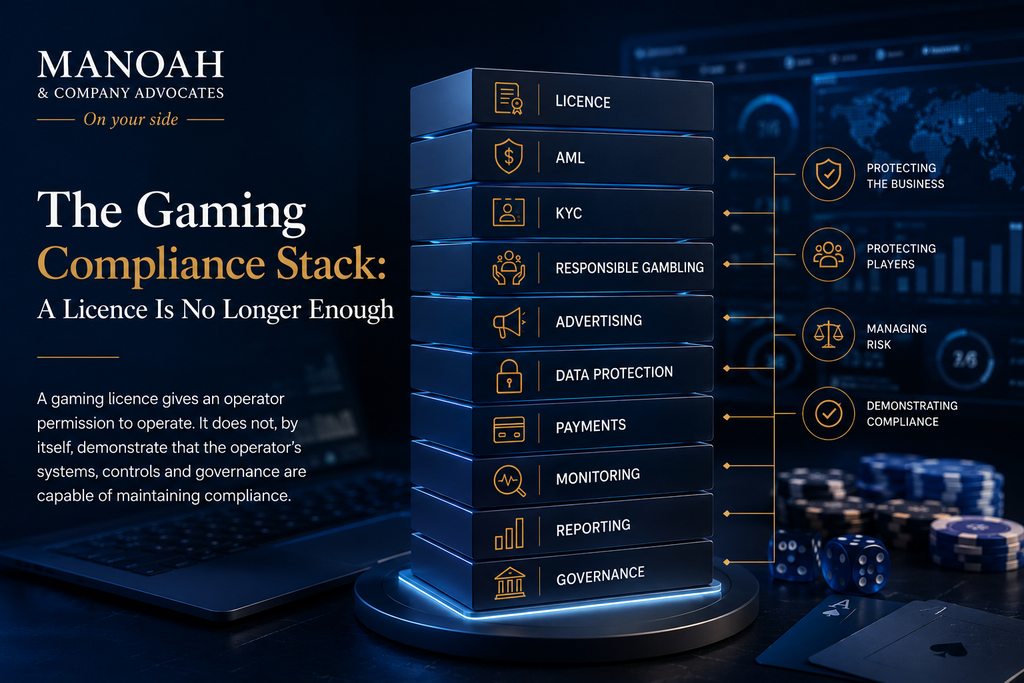
The modern gaming compliance framework can be viewed as a compliance stack:
Licence – The foundation. Operators must obtain the appropriate licence and maintain compliance with its conditions throughout the life of the business.
AML and KYC – Customer identification, verification, transaction monitoring and suspicious activity controls must work together to identify and mitigate financial crime risks.
Responsible Gambling – Operators must have effective measures to protect minors and vulnerable customers, identify problematic gambling behaviour and support responsible participation.
Advertising – Marketing and promotional activity must be subject to appropriate legal and compliance controls. This extends beyond traditional advertising to digital campaigns, promotions and third-party marketing channels.
Data Protection – Gaming platforms process significant volumes of personal data. Data governance, security, retention, access and lawful processing should therefore be embedded within the broader compliance framework.
Payments – Deposits, withdrawals and prize payments introduce regulatory, fraud and consumer-protection considerations requiring appropriate controls and oversight.
Monitoring and Reporting – Compliance cannot be demonstrated through policies alone. Operators must be able to monitor risks, identify breaches or anomalies, maintain appropriate records and discharge applicable reporting obligations.
Governance – Ultimately, responsibility for compliance rests with the organisation’s leadership. Boards and senior management require sufficient visibility over regulatory risks, controls, incidents and remediation to exercise effective oversight.
The significance of the stack lies in the interdependence of its components. Weak KYC controls can compromise AML systems. Inadequate data governance can undermine responsible gambling measures. Weak monitoring can render otherwise well-designed policies ineffective.
For operators, the regulatory question is therefore evolving.
It is no longer simply: “Do we hold a valid gaming licence?”
It is: “Can we demonstrate that our business is structured, controlled and governed to remain compliant?”
That distinction matters. Licensing establishes the right to operate. A functioning compliance architecture demonstrates the capacity to operate responsibly, sustainably and within the regulatory framework.
At Manoah & Company Advocates, we advise gaming businesses on regulatory compliance, governance, risk management and the development of practical compliance frameworks designed to support sustainable operations.
In gaming, compliance is not a licence. It is an operating system.