
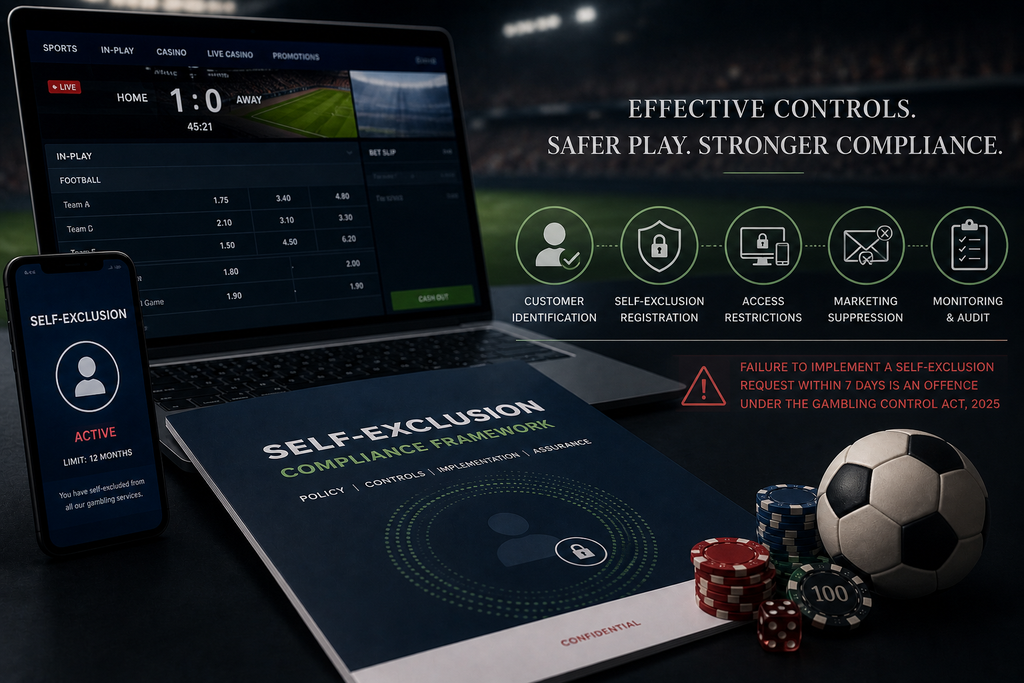
Self-exclusion is increasingly becoming a material regulatory risk for gaming operators. Under Kenya’s Gambling Control Act, 2025, licensees are required not merely to offer a self-exclusion mechanism, but to take reasonable steps to ensure that an excluded customer cannot continue to access gambling services.
The distinction is important. For operators, the regulatory question is no longer simply whether an appropriate policy is in place. It is whether the operator can demonstrate that its systems and controls operate effectively when a customer elects to self-exclude.
The statutory obligations
Section 115 of the Act establishes a framework under which an individual may enter into a self-exclusion agreement covering gambling establishments, controlled games and online gambling. The Authority is required to maintain a register and notify licensees of self-exclusion agreements.
Licensees must establish mechanisms to give effect to self-exclusion, take reasonable steps to prevent participation in gambling, suppress marketing communications, remove the customer’s details from marketing databases within two days, close relevant customer accounts and return funds held in those accounts. They must also implement procedures designed to prevent the customer from subsequently accessing their gambling services.
The consequences of non-compliance are potentially significant. Failure to implement a self-exclusion request within seven days of written notification constitutes an offence punishable by a fine of up to KES 1 million, imprisonment for up to one year, or both.
Where enforcement risk arises
The principal risk is likely to arise at the level of implementation and controls.
Duplicate or linked accounts, inadequate identity verification, fragmented customer databases, ineffective marketing suppression and failures to communicate exclusion information across platforms can undermine an otherwise compliant framework.
Accordingly, self-exclusion should be treated as a systems, governance and regulatory-control issue, rather than solely as a customer-service function.
What should operators test?
Operators should assess whether their controls:
- capture and verify requests promptly;
- identify linked or duplicate accounts;
- prevent access across relevant channels;
- suppress marketing communications;
- provide clear escalation and accountability procedures; and
- maintain an auditable record of compliance.
The regulatory framework also contemplates further guidelines on self-exclusion and other gambler-exclusion mechanisms.
For gaming companies, the immediate priority should therefore be to establish not only compliant policies, but demonstrably effective controls.
As enforcement under the new framework develops, operators should consider whether their existing arrangements would withstand regulatory scrutiny and whether they can produce the evidence necessary to demonstrate compliance.
Manoah & Company Advocates advises gaming and betting businesses on regulatory compliance, licensing, governance, risk management and enforcement matters in Kenya. Please reach us through info@manoahadvocates.co.ke .