Infrastructure investors no longer need to wait for government tenders to identify bankable opportunities. In any event, Kenya’s infrastructure ambitions have long outpaced the public purse. The Public Private Partnerships Act, 2021 (“the PPP Act”) responds to this gap by giving private investors a formal route to originate, rather than merely bid for, public infrastructure projects. This route, the Privately Initiated Proposal (“PIP”), is increasingly visible in Kenya’s power, transport and water sectors, and is worth understanding for any investor, contractor or financier eyeing opportunities in Kenyan public infrastructure.
What is a PIP?
A PIP is a proposal for an infrastructure or development project that a private party originates and submits to a contracting authority on its own initiative, without having been invited to bid. Unlike a conventional tender response, a PIP places the burden on the proponent to make the case for the project from the outset, including justifying why open competitive bidding would not be the more suitable procurement route.
The Legal Framework
Sections 40 to 44 of the PPP Act set out the PIP process in detail:
- Submission (section 40): A private party submits its proposal directly to the relevant contracting authority, which in turn forwards it to the Public Private Partnerships Directorate for assessment. A non-refundable review fee, the lower of 0.5% of the estimated project cost or USD 50,000, is payable into the PPP Project Facilitation Fund at the point of submission.
- Due diligence (section 41): Before any substantive evaluation begins, the Directorate, working with the Contracting Authority, must satisfy itself as to the integrity of the proponent, including checks on debarment, corruption, insolvency and tax compliance.
- Evaluation (section 42): The Directorate and contracting authority assess the proposal against established criteria covering project feasibility, suitability for a PPP structure, and affordability, and must conclude this evaluation within 90 days of submission. The Directorate then reports to the PPP Committee, which has 14 working days to decide whether the project may proceed to project development.
- Project development (section 43): Once approved, the proponent has six months (extendable on justified application) to complete the activities needed to move the project toward approval.
- Procurement design (section 44): This is where the PIP process diverges depending on market interest. Where only one proposal is received, the Contracting Authority may negotiate directly with the proponent. Where competing proposals are received for the same project, a restricted tender limited to those proponents may be used. Where the contracting authority considers that genuine market competition would deliver better value for money, it may instead opt for open competitive tender.
Public Disclosure
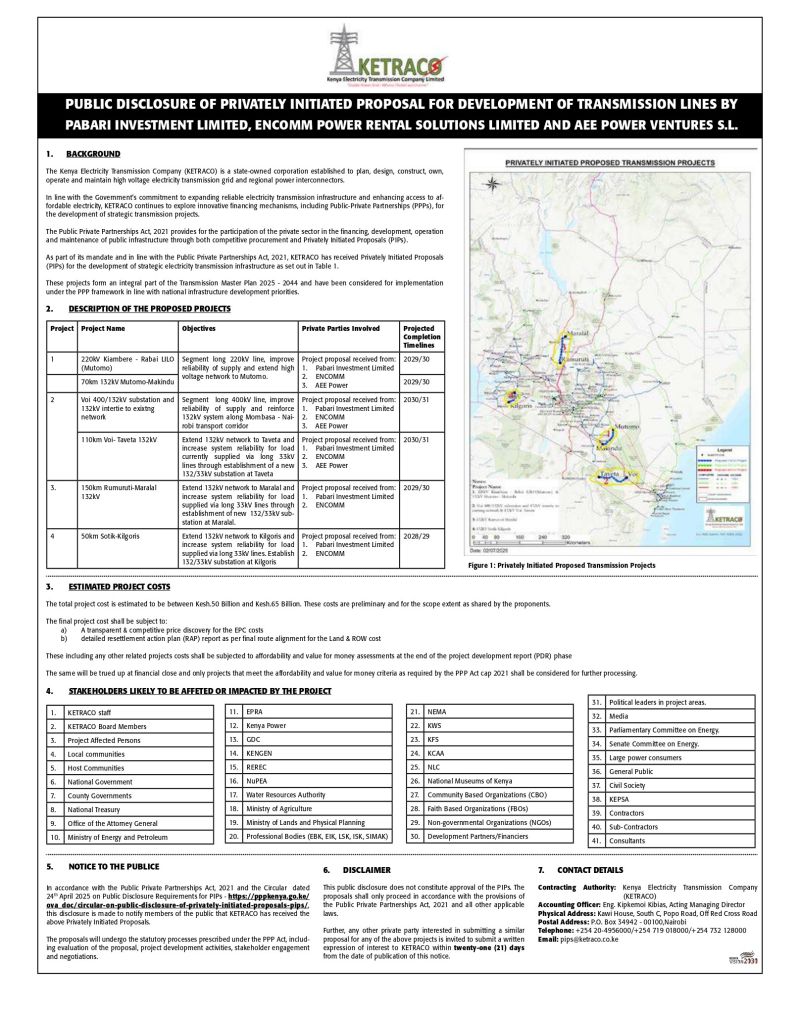
A defining feature of the current framework is transparency. Contracting Authorities are expected to publicly disclose that a PIP has been received, typically through a notice identifying the proponent, the nature of the project, indicative costs and timelines, and the stakeholders likely to be affected. This practice, recently reinforced by National Treasury guidance on public disclosure of PIPs, is intended to guard against the perception (long associated with unsolicited proposals in Kenya) that such projects are negotiated away from public scrutiny.
Practical Considerations for Investors
For private parties considering the PIP route, a few points are worth bearing in mind:
- Front-load the feasibility case. Because a PIP must justify itself against the alternative of open tender, the strength of the technical, financial and legal groundwork submitted at the outset materially affects the odds of approval.
- Budget for the review fee and the diligence process. The review fee is non-refundable and does not obligate the Contracting Authority in any way, approval is not guaranteed simply because a fee has been paid.
- Anticipate competition. A well-publicised PIP can attract rival proposals for the same asset, converting what began as an unsolicited proposal into a restricted or open tender.
- Plan for stakeholder engagement early. Given the disclosure obligations and the affected-stakeholder mapping contracting authorities are expected to undertake, proponents that engage credibly with communities, county governments and regulators from the outset tend to move through evaluation more smoothly.
Conclusion
The PIP mechanism gives private investors real agency in shaping Kenya’s infrastructure pipeline, but it is not a shortcut around rigorous evaluation or public accountability. For sponsors, financiers and developers, a well-structured PIP can create a first mover advantage in Kenya’s infrastructure market. However, success depends on rigorous legal structuring, careful stakeholder management and a proposal capable of withstanding both statutory scrutiny and commercial competition.
This article is provided by Manoah & Company Advocates for general information purposes only and does not constitute legal advice. For advice specific to a proposed project, please get in touch with our team through info@manoahadvocates.co.ke.